Your dog sees the toothbrush and disappears. Your cat turns their head before you even lift a lip. If that sounds familiar, start with a smaller goal: a calm moment near the tools.
Pause brushing, check for signs of discomfort, and introduce mouth handling in tiny, rewarded steps. An access tool may help you see or reach teeth once your pet accepts it. It cannot make a frightened pet comfortable.
First, is your pet frightened—or uncomfortable?
Some pets dislike unfamiliar objects or having their face touched. Resistance can also have a physical cause. A sudden change deserves particular attention.
| What you notice | A useful next step |
|---|---|
| Turns away when the brush appears, before you touch the mouth | Practise calm introductions without brushing. |
| Bleeding, swelling, trouble eating, or apparent pain | Stop home cleaning and arrange a veterinary assessment. |
| Growling, snapping, struggling, or trying to escape | End the session. Do not restrain the mouth or put fingers inside. |
These observations are not a diagnosis. Cornell notes that dental disease can cause oral pain and that brushing inflamed gums may be painful. Read Cornell’s feline dental guidance.
A calmer way to introduce brushing
Work through these stages at your pet’s pace. They are not a five-day schedule. Stay with an easy stage until your pet is comfortable; go back a stage if they become uneasy.
- Let the tool be boring. Leave the brush within view, at a comfortable distance. Reward calm interest. Do not follow your pet around with it.
- Practise a brief cheek touch. Touch the outside of the face, release, then reward. Finish before your pet needs to pull away.
- Try a gentle lip lift. Only progress when face touching is accepted. You can often see the outer tooth surfaces by lifting the lip; you do not need to force the jaws apart.
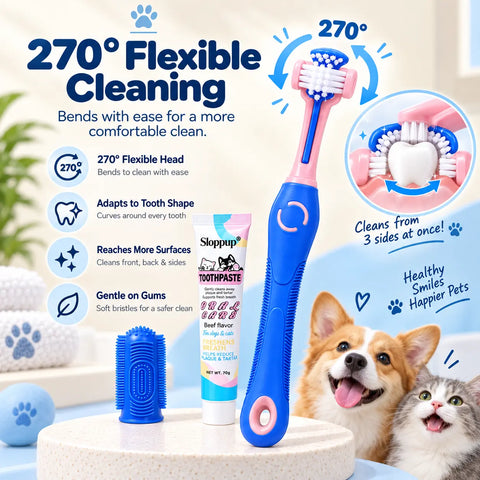
- Introduce a suitable pet toothpaste and soft brush. Use toothpaste intended for your pet’s species, not human toothpaste. Begin with the smallest amount of brushing your pet accepts.
- Build gradually. A few comfortable brush strokes are a starting point. Increase coverage over repeated sessions rather than trying to finish the whole mouth immediately.
Cornell recommends treating toothbrushing as a training session and gradually adding brush strokes over multiple sessions. See the dog toothbrushing guide.
When an access tool may help
Sometimes a pet accepts handling, but you still cannot see the back teeth clearly or position the brush comfortably. That is a different problem from fear. Our two accessories are designed to help with access during supervised care.

Blue Mouth Opener & Chew Assistant: for dogs
A supervised accessory for dogs who already accept the tool. The two-pack can support access while you position a toothbrush according to the product instructions.
Choose it for: a dog who accepts handling but needs a practical brushing accessory.
Skip it for: cats, a painful mouth, or a dog who is resisting.

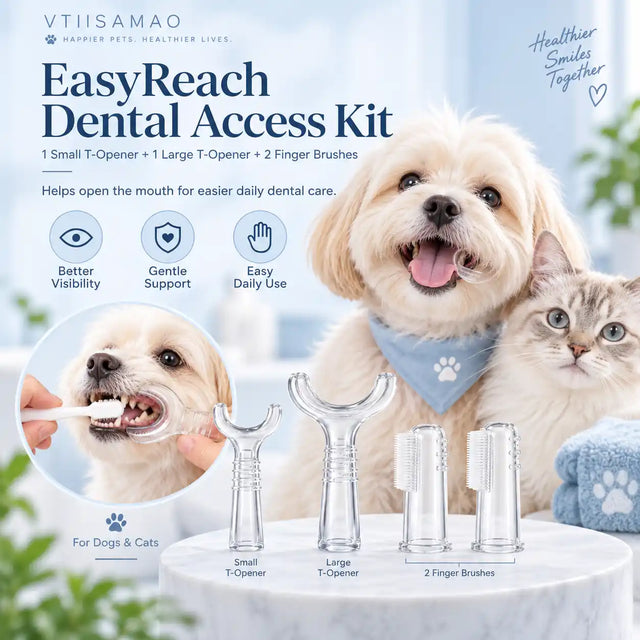
Clear Dental Access Set: for dogs and cats
The four-piece set includes small and large T-openers plus two finger brushes. It is designed to move lips and cheeks aside for visibility and access.
Choose it for: a pet who accepts gentle handling, when seeing the teeth clearly is the main difficulty.
Remember: use only as directed, select a suitable fit, and stop if your pet resists. Finger brushes do not protect against bites.

Neither accessory is a restraint or a treatment for dental disease. Never use a cord or opener to override resistance, and never leave your pet unattended with a tool. Check for damage before use and follow the product instructions.
“What if my pet still won’t let me brush?”
That is a reason to adjust the plan, not hold them tighter. Ask your veterinarian about mouth pain, appropriate home-care options, and help with cooperative handling. You can also ask about products with evidence for plaque control while you work on brushing.
Regular brushing remains an important part of dental care. Tools that improve access do not replace brushing, a veterinary examination, or professional treatment when needed. AVMA pet dental care guidance.
Three quick questions
Should I hold my pet’s mouth open to get it done?
No. Stop if your pet struggles or shows distress. Start again with an easier handling step, or seek help if you cannot proceed comfortably.
Can I use the blue mouth opener for my cat?
No. The blue Mouth Opener & Chew Assistant is for dogs. The clear set is labelled for dogs and cats, but suitability and acceptance still matter.
Will an opener remove existing tartar?
No. These are access and brushing accessories. If you see heavy hardened buildup, inflamed gums, or signs of discomfort, ask your veterinarian about appropriate care.
Written by Vtiisamao. General education, not an individual diagnosis. Product details describe our accessories; the veterinary references do not imply endorsement of Vtiisamao products.